

A Memorable Journey to Israel’s North with JDC
Rolinda Schonwald got to see a cross-section of JDC's work in Israel's battered North — an unforgettable experience she encourages others to have for themselves.
By Rolinda Schonwald - JDC Supporter | August 7, 2025
When Rolinda Schonwald joined a recent JDC mission to Tamra, Israel — an Israeli Arab city in the country’s North — as well as Migdal HaEmek, a high-tech hub for Israeli companies, she witnessed firsthand our robust humanitarian response to the war. In this reflection, Schonwald offers her impressions of JDC’s on-the-ground work, as well as the powerful conversations she had with some of the country’s most vulnerable Israelis.
Israelis have gotten used to running for shelter when notified of incoming missiles. During the recent Iranian ballistic missile attacks, that intensified.
Ballistic missiles, unlike conventional ones, are huge, weighing thousands of pounds. They travel high — at least seven kilometers — in the sky. When they approach Israeli territory, they explode, releasing hundreds of cluster bomblets into a wide area, hence the difficulty of predicting where they will explode and intercepting them before they can do massive damage.
Israeli Home Front Command redesigned its system for informing the population when to take cover. Israel’s war with Iran, called Rising Lion, ratcheted up the level of tension for all residents of the country, with unpredictable alerts from the Home Front Command. The new protocol, received on our cell phones whether the sound is turned off or not, emits an eerie, rustling noise that vibrates us awake.
The situation was dire. Large areas around Tel Aviv, Jerusalem, and even the Dead Sea communities had 25 minutes to run for shelter. As the missiles came closer, the air-raid sirens in areas likely to be impacted wailed. Then we had to scramble for shelter.
As hard as that is for able-bodied people to get used to, imagine what it’s like for the elderly, those with disabilities, and the injured. That is why Israel’s hospitals moved patients to fortified underground facilities. A surgical ward in Be’er Sheva’s Soroka Medical Center was evacuated 12 hours before it was destroyed in a missile attack.
On a recent visit to Israel’s North organized by JDC, we visited two locations — a high-tech hub in Migdal HaEmek called Flex, and the small Arab city of Tamra in the Galilee.
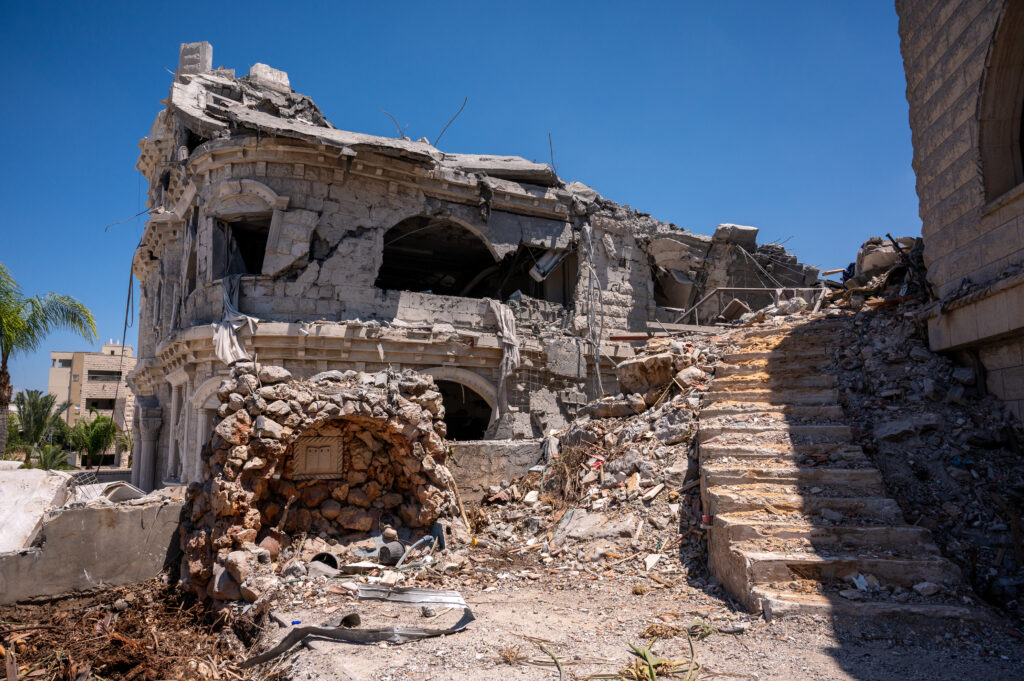
Tamra was recently catapulted into the public eye when a ballistic missile struck the home of a prominent lawyer, killing his wife, their two daughters, and his sister-in-law. Though the family had a bomb shelter, the blast was too strong to withstand.
We viewed the wreckage from the heavily damaged home of the next-door neighbors, who survived the missile attack in a bomb shelter beneath their stairwell. Their beautiful home is too damaged to live in, but we were given water and taken upstairs to see where the missile landed.
We met a first responder who’d finished a JDC training course through the Al-Manara (“Lighthouse”) emergency initiative just months before the bombing. He showed us his tools and shared his memories — how he’d braved the danger of climbing over the unstable rubble to find faint signs of life in one girl, too badly injured to survive. He’d collected the body parts of the women next door. As he spoke, he wept, and we wept with him.
Joining us at the neighbors’ were social workers and other city officials. The social workers assigned to this case, immensely compassionate Muslim women, described the increased social service needs of the city, where JDC operates several essential projects in the municipality. Israeli Arab villages and towns are often underserved compared to their Jewish contemporaries, so this support is crucial for their well-being.
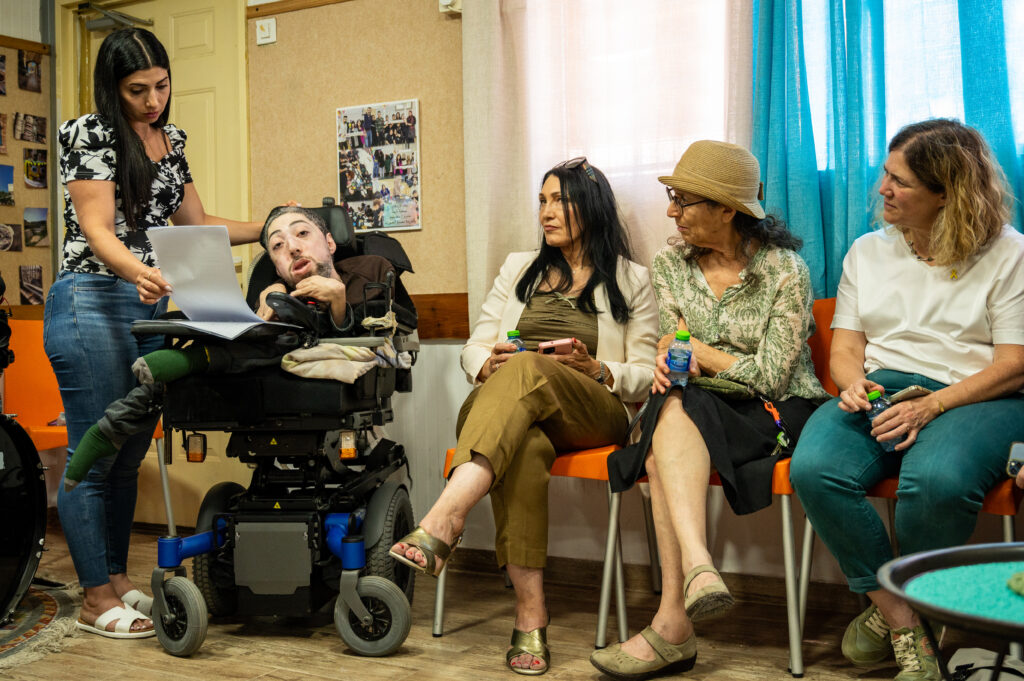
We then visited the Shahd Association, a remarkable organization of adults with disabilities who, having been isolated during the COVID-19 pandemic, now have to deal with loneliness during the war. Most were in wheelchairs.
They performed a musical interlude and briefed us on the need for JDC’s partnership, which provides vital services for adults with disabilities. Until they’re 21, youngsters with disabilities are offered physical therapy, education and a place to gather, but once they reach adulthood, they lose some of these essential benefits.
JDC and the Shahd Association help fill that gap. Already, they’ve worked with the community to create an accessible park, provide support for higher education, and so much more.
During our visit, a writer named Fadi Abushkara addressed us from his wheelchair, reading a speech he’d written in English. Abushkara wrote a book describing what it’s like to live in a severely disabled body, dependent on an oxygen tank and a wheelchair, with an attendant present 24/7. He is a shining example of Israeli strength and resilience. The title of his 2018 book is Hostage to My Body, and I told him I want to read it when it comes out in English translation.
Another man at the gathering, also in a wheelchair, described what it’s like to hear air-raid sirens at unpredictable moments, like in the middle of the night. Even though the new Home Front Command guidelines now advise more time to get to shelter, for those with disabilities, reliant on caregivers to bring them, there is simply never enough time.
“I decided to stay in my bed,” the man told us. “If I die, so be it.”
We also met the mayor of the city, who addressed us in Hebrew, thanking us for JDC’s partnership providing essential services in the city. The mayor was delighted to meet my sister, Tamara, whose name is almost the same as the city he serves.
“I decided to stay in bed,” one man told us. “If I die, so be it.”
Next, we visited Flex, a tech hub in Migdal HaEmek.
Given the impact of the war, there is a shortage of engineers in Israel’s North. JDC has a program there to retrain engineers to fill the many jobs in Israel’s manufacturing sector. There’s a high demand for them and software technicians at companies like Intel, Microsoft, Nvidia, Apple, HP, Amazon and Raphael, to name a few of the big ones, as well as Johnson and Johnson, Philips, Inmode, Orca, Tytocare, Motorola, Cisco, Siklia, Nice, Nuvo, and Verint.
Who knew there was such a high demand for practical engineers and debug technicians in Israel?
Tytocare’s product — a device that monitors pediatric ear infections — is something I wish my grandmother, mother, daughters, and I had access to. This tool sends data to your pediatrician who can easily determine whether your child has an ear infection, all done remotely.
The war has affected jobs across all sectors, and now that threats from Lebanon have lessened in the North and evacuated citizens are returning, living in the Galilee is once more an inviting option. Our meeting with some of the newly retooled and trained technicians, both Jewish and Arab, was lively and fascinating.
I feel enormously grateful to have had an insider’s look at JDC’s invaluable work in Tamra.
A dedicated JDC supporter as well as board member of the Rochlin Foundation. Rolinda Schonwald lives in Jerusalem, Israel.
Sign Up for JDC Voices Stories
Share


Share
Partners


Give With Confidence


