

Hope Always Appears, Even in the Darkest Times: This Elderly Jew Reflects on Purim
After surviving famine, war, and a near-death experience, Klara Lazuka has some hard-earned wisdom to share with the world.
By Klara Lazuka - JDC Client; Konotop, Ukraine | March 1, 2026
The word “resilience” is used often in these challenging days for the global Jewish community, but few people embody that term more than Klara Lazuka — a Holocaust survivor who has endured war, famine, sickness, and evacuation, among other profound obstacles. Though her life has been difficult, Klara, 91, has found the strength to persist through the JDC-supported Hesed Haim social service center in Konotop, Ukraine.
As we celebrate Purim, Klara connects her life to the themes of Jewish resilience — and teaches us all a lesson about what it means to thrive in the face of great difficulties.
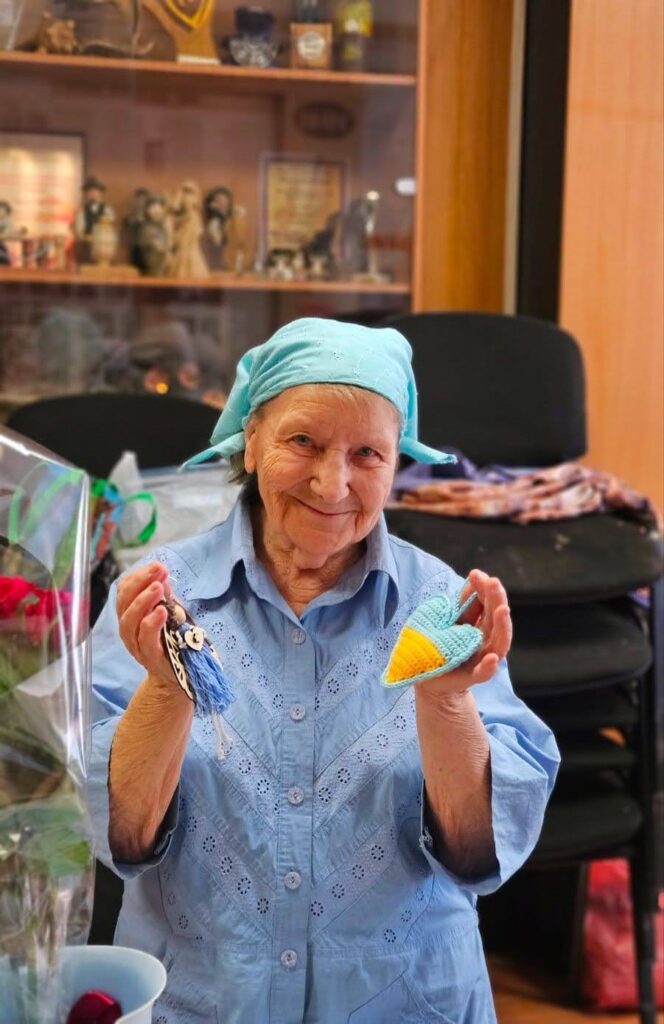
My life began with the Second World War. I still remember the fear, the explosions, and the journey into the unknown. We survived only because we helped each other — but I don’t want to get ahead of myself.
When the war began, my father was called to the front, and my mother was left alone with us children. We fled our native Poland and arrived in Konotop in Soviet Ukraine. But then the bombing started there, and we were forced to urgently evacuate to Kazakhstan, as many others were forced to do during the war.
We took only the bare necessities. My mother prepared suitcases for us, but at the last minute, my sister grabbed her gramophone rather than clothes. She loved music and thought we’d return soon — we could listen to music in our temporary home.
This gramophone traveled with us all the way from Konotop to Kazakhstan — it was a small luxury and a memory of joyful times with our father, and it helped distract us from the sadness.
With the railway station in Konotop destroyed, my grandfather hired a horse-drawn carriage and took us to the next stop. We dodged bombs the entire way, and the horses reared at each explosion.
Finally, we caught a train bound for Kazakhstan, sleeping at stations along the way. People huddled together — there were no blankets — resting wherever they could, using only their coats for cover. My sister and I got sick with measles and pleurisy.
When we arrived in Kazakhstan, we lived in the house of a local woman. My mother went to work each day, and the woman left, too. Only the father of the house remained at home, but he was bedridden. We, the little ones, tended the stove as best we could, keeping the house warm.
One day, my older sister closed the chimney damper, thinking it would keep the heat in. At first, we felt dizzy; then, we lost consciousness. Luckily, the woman returned home, dragged us out of the house, and called for help.
We learned that we’d almost died of smoke poisoning.
When we returned to Konotop, my father had already died at the front, leaving my mother to support us alone. Our grandparents’ apartment was occupied by strangers, and we were given housing in a basement. It was very cold and damp there. We cooked and slept in one room.
Life after the war was difficult for everyone. People were more concerned with survival. In the Soviet Union, Jewish life was repressed, so everyone kept quiet about their identity. In those days, we knew to be cautious.
At the same time, I found myself surrounded by children from Jewish families. It was a natural feeling of closeness and support. Though all of us were, as we used to say, “children of the Soviets,” with identical uniforms, our Jewish eyes somehow still saw each other — we never forgot who we were!
When the Soviet Union collapsed, we were finally able to say the word “Jew” out loud, without fear of sidelong glances. Many of us began to remember our traditions, others discovered them for the first time. All of us started participating in Shabbat celebrations, holiday gatherings, classes on Jewish history and culture, and more dynamic programming.
There was one place this Jewish revival happened — the JDC-supported Hesed Haim social service center here in Konotop.
The 1990s were bittersweet. Though the fall of the Soviet Union sparked this renewal of Jewish life, many of us lost everything we’d spent decades working for. And today, my pension is so meager I can’t even pay for basic necessities.
But through JDC and the Claims Conference — the organization’s partner in caring for Holocaust survivors like me — I receive everything I need: food, medicine, homecare, and other life-saving aid. With the weather still frigid, JDC’s winter assistance is especially crucial right now, and they supply fuel for heat, warm clothing, and heavy blankets. Without this help, I’d simply freeze.
If the cold is intolerable, then the loneliness is utterly excruciating. I’m at an age when my friends are passing away, and communication with them is becoming infrequent. None of my family members live nearby. To make matters worse, I’m unable to climb down the long flight of stairs by myself. My world is basically confined to my apartment.
While there’s still light outside, I sit by the window and use a magnifying glass to solve crossword puzzles. But even that is becoming difficult — one of my eyes is clouded over by cataracts. I’d like to entertain myself, but it’s tricky. I don’t want to burden anyone.
As lonely as I feel, I’m never hopeless. For several years, my homecare worker has been my lifeline, assisting with household tasks I’m no longer capable of doing and running essential errands. I’m unable to go to the grocery store on my own, but I know she’ll deliver the nutritious food I need. And if I want to go to a celebration at Hesed Haim, she even helps me get down those endless flights of stairs.
If it weren’t for JDC, I don’t know how elderly Jews like myself would cope. The constant calls, the attention, the concern — it’s not just material support, it’s human compassion. Knowing that you’re remembered each day, that you’re not alone with your fears, gives you a tremendous sense of relief. The meetings and visits keep me going; I eagerly await the staff and volunteers as if they were my children and grandchildren.
The visits keep me going — I eagerly await JDC staff and volunteers as if they were my grandchildren.
Sometimes I think about how much suffering I’ve endured, how many situations I encountered during the Second World War that could’ve ended my life. I experienced evacuation, illnesses, the loss of my father, a severe drought, crop failures, a year of famine, where bread and strength were nowhere in sight. It sometimes seemed like my life hung by a thread.
And yet, I survived.
All of Jewish history is a story of people trying to break us, intimidate us, and destroy us. But we still managed to thrive. And my life, if you think about it, is one more example of this.
Purim reminds us that salvation doesn’t always come loudly. Sometimes it comes through the people around us, through chance, through someone’s kindness, through a hand extended at the right moment — like now, when we elderly Jews are cared for and not allowed to be alone.
As long as we hold on to each other, as long as we don’t ignore the misfortunes of others, we have a future. Our relationships are our true source of wealth. I’m as certain of this as my life is long: When people are together, hope always appears, even in the darkest times.
JDC and its dedicated supporters are that hope. May your families be protected by God each day — and may you know that there are thousands of Jews who are alive, healthy, and fed only thanks only to your care, initiative, and generous souls.
Klara Lazuka, 91, is a JDC client in Konotop, Ukraine.
Sign Up for JDC Voices Stories
Share


Share
Partners


Give With Confidence


