

“No Time to Mourn” : These Elderly Jewish Sisters Open Up on Tisha B’Av
These two sisters have supported each other through the worst catastrophes imaginable — and on Tisha B'Av, they have a message for Jews everywhere.
By The JDC Team | August 1, 2025
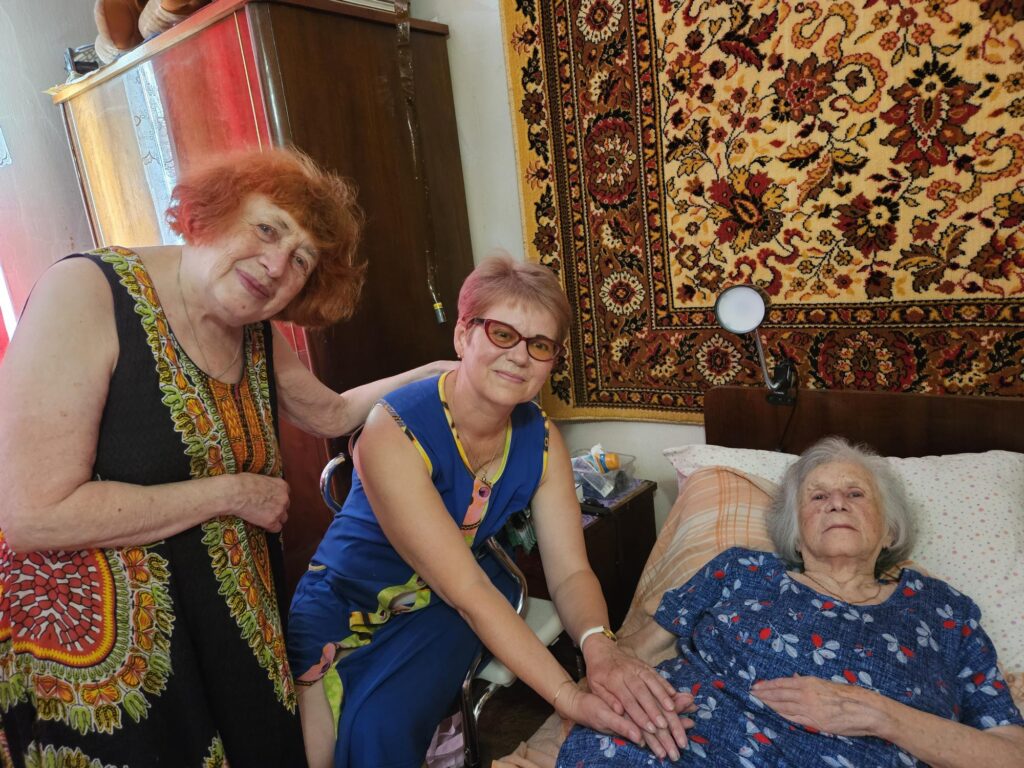
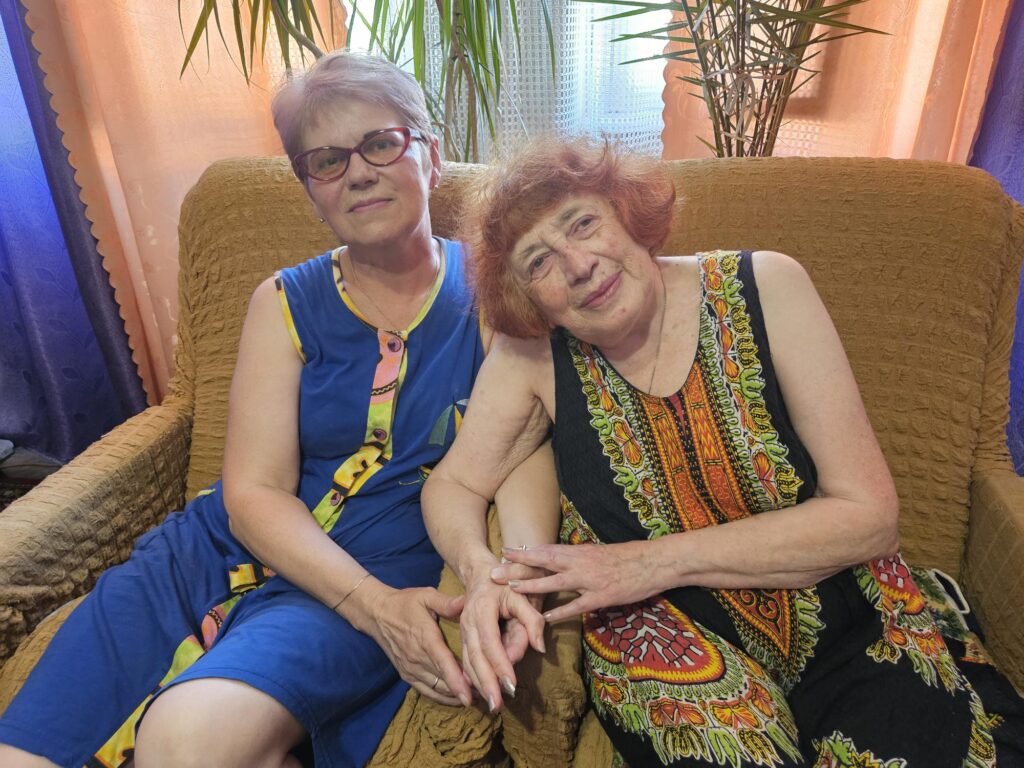
Tamara and Valentina Shpolskie survived the Second World War, lived through the collapse of the Soviet Union, and are now enduring the conflict in Ukraine. But no matter what challenges they’ve faced, the Shpolskie sisters have had each other — and today, they also have the JDC-supported Hesed Emuna social service center in their hometown of Chernivtsi, Ukraine. As we mark Tisha B’Av, Tamara, 84, and Valentina, 93, open up about their life together, moments both difficult and joyful, and how JDC has been by their side the whole time.
Q: Describe your Jewish life growing up. Are there any special memories or traditions?
Tamara Shpolskie: We didn’t observe Jewish traditions growing up, but our grandparents tried to be observant. On Fridays, they’d shut the curtains and light Shabbat candles. When I was 5 years old, I remember our neighbors gathering in our house to read prayers. For Passover, matzah was baked and people would bring whole suitcases full of it back home with them.
Maybe it was thanks to our grandparents that Valentina used to make the best gefilte fish I’ve ever tried. On Passover, we ask our homecare worker to make “gefrishte matzah” — matzah pancakes.
Valentina Shpolskie: When we were evacuated to northern Kazakhstan during the Second World War, I remember there was one Jew who knew all the holidays — he’d secretly gather all the rest of us in a local bathhouse to read prayers.
Q: Valentina, you were 10 years old when the Nazis invaded Ukraine. What do you remember about this time? What was most difficult?
VS: Each day and night was a lottery. We never knew what would happen next and whether we’d survive. My sister was just a newborn. We were evacuated in a freight car without a roof. The journey was long, and there were so many people around us. Everyone was hungry and thirsty. A child myself, I was so worried about Tamara. And our troubles didn’t end once we arrived at our new home of Aktyubinsk, Kazakhstan — it was freezing and desolate.
Q:What’s the hardest thing about living on your pension?
TS: The hardest thing is that we’re getting older and our health is worsening. We need a lot of medicine, and it gets more expensive each day. Without JDC’s help, we’d be forced to spend our entire pension on medication. We’d have nothing left to pay for food or utilities.
Q: How did you both connect to Hesed Emuna? What kind of support do they provide?
VS: We learned about Hesed Emuna when it opened 25 years ago. Tamara was still working at that time. We went there to volunteer at events like Kabbalat Shabbat and holiday celebrations. We also participated in various programs and activities.
It was our “warm home,” our family. There, at Hesed, we started feeling fully Jewish. It was like reclaiming something that had been lost. We were happy and proud of that.
Q: What’s your favorite JDC program? Why?
TS: We adore any JOINTECH program — JOINTECH being an initiative that distributes specially designed smartphones so that homebound Jewish seniors like me and Valentina can participate in Jewish life. We love Iryna, who leads virtual seminars on Jewish culture, history, literature, and traditions. Valentina hears better than I do, so if I miss anything, she tells me!
VS: I also love Shabbat. JDC brings us challah and there are Shabbat programs on our smartphones. I think Friday is a very special day in the life of any Jew. It’s a time when you get in touch with what life’s all about. You get to be thankful for a day of rest and the week ahead of you.
Q: Tell us about your JDC homecare worker. What do you appreciate about them?
VS: Now that our health has deteriorated and we need more help, we rely even more on our homecare worker. She is wonderful — in fact, she’s just like family. She brings us groceries and medicine, cooks meals, and helps with urgent tasks around the house.
But the most important thing is this: She’s always with us, both physically and emotionally. She’ll even pick up the phone if she’s off-duty. She truly cares.
TS: We’re thankful to her for her open heart and smile. She encourages us even at the most difficult times.
Q: Tell us about Feb. 24, 2022 — the start of the conflict in Ukraine. How did that day unfold for you?
TS: We’ll always remember that morning. Larisa, our homecare worker, came to us and said, “Cities are being bombed. People are fleeing.” At first, we didn’t believe her. But then we read the news.
It was a flashback for Valentina. I was afraid for her. She remembered the Second World War, those cold and hungry days. This summer, missiles rained down on our town. I didn’t know it was happening because of my poor hearing, but my poor sister… People were killed and wounded.
We still can’t believe that a nightmare like this is happening in our lives again. How can it take place, after all the horrors of the Second World War and the Holocaust?
VS: The worst part was the anxiety, uncertainty, and fear — the fear that we’ll starve or quite literally be left out in the cold.
Q: How has JDC supported you throughout this difficult time?
TS: We always knew JDC would be there for us: They never disappeared, not even for an instant. From the very beginning, they were in constant contact. Any help we needed — whether that was food, medicine, help with utilities (which are incredibly expensive now) — they gave without hesitation.
But, again, the most important thing is that we always know we’re not alone.
Q: More than three years after the conflict began, what’s changed for you? What remains challenging?
VS: For more than three years, we hadn’t endured what people in Kharkiv, Kyiv, or Odesa have felt. We didn’t hear missiles or drones. But this summer has changed a lot. We now realize how fragile our days and nights are. That’s why, even when we don’t feel good, we still try to enjoy every moment of our lives — talking with one another, with our people at Hesed Emuna, learning something new from JOINTECH, and meeting our peers. All of these moments are priceless.
We still can’t believe that a nightmare like this is happening in our lives again. How can it take place, after all the horrors of the Second World War and the Holocaust?
Q: You’ve both endured so much together. What’s the one thing you love most about each other?
TS: We support each other. We never quarrel. If and when appropriate, we try to treat most situations with humor.
VS: We know that every person is given a life for something. We both try to decorate each other’s lives with love and care. To support her, I tell Tamara about our childhood years, when she was still a baby and I was almost a teenager. We speak about our parents when they were younger and our grandparents. We also look at family photos. Remembering our family gives us strength.
Q: On Tisha B’Av Jews around the world mourn the various catastrophes that have befallen us. You’ve lived through the Second World War and now the conflict in Ukraine. In these difficult times, what do you feel like you’re “mourning”? And what’s your source of strength and hope?
TS: We have no time to mourn — we do our best to be strong. Each morning, we wake up and see the sun. It’s a beautiful thing. My sister is with me. That’s a gift. We are together in our home. But not only that, we’re together with our larger Jewish family: JDC and our local community.
To be close and together, this is what gives us energy, resilience and hope.
VS: As Jews, it is our duty to share what we have with the most vulnerable among us. Mutual responsibility is a pillar of our tradition. That’s the reason why we, Jewish people, are still alive.
Please send our biggest thanks to JDC’s supporters. We are in awe of their noble deeds. Each and every day, they think of us and so many others, those whom they do not even know.
Tamara and Valentina Shpolskie are sisters and JDC clients living in Chernivtsi, Ukraine.
Sign Up for JDC Voices Stories
Share


Share
Partners


Give With Confidence


