

Pride 2026: In Argentina and Beyond, Widening Our Tent for LGBTQ+ Jews
In Andrew Belinfante's view, the future of Jewish life depends on all of us — including LGBTQ+ Jews.
By Andrew Belinfante - Senior Director of Programs & Organizational Development, JDC Entwine | June 17, 2026
What makes LGBTQ+ inclusion a core Jewish value? Andrew Belinfante has a compelling answer grounded in his own lived experience. As senior director of programs and organizational development for JDC Entwine, Belinfante helps create immersive travel experiences that enable young Jews to learn about JDC’s global work and witness Jewish life worldwide.
With Pride Month being marked around the world, he reflects on the crucial role LGBTQ+ Jews play in powering the future, and why Jewish communities are only as resilient as their tents are wide.
In a synagogue in Buenos Aires, Romina and Victoria sat next to each other and told us, with no particular fanfare, that they had been the first lesbian couple to be married under an egalitarian chuppah in Argentina. The way Romina told it, the chuppah had been simply two people who wanted to love each other alongside a community that wanted to help them, and a ceremony that honored both. The story arrived the way you might hear about the wedding of a close friend or family member. It was ordinary, but also joyful. They had wanted to get married, and the marriage happened.
Romina Charur is the director of Judios Argentinos Gays (JAG), an organization that began in 2004 with support from JDC. Victoria, her wife, sat next to her. We were there as a group of queer Jewish young professionals on a JDC Entwine Insider Trip designed to explore Argentina’s Jewish community through a queer lens. What we heard over and over again in their voices was not pride in their own courage; it was gratitude for a community that had stayed with its own discomfort, knowing it needed to make space without knowing how, until the wedding became possible.
The Argentine Jewish community could have offered a tolerant smile and let them figure out the rest. Instead, an egalitarian chuppah came into being. The wedding that happened, in the end, was the act of a community deciding it was time to widen their tent.
Sitting in that room as a queer person, alongside 22 other queer young professionals from around the world, what meant so much to me was the ordinariness of how Romina and Victoria spoke. They could have been telling us about a fight they had won. Instead, they were telling us about a wedding. Their wedding, in their community, with their rabbis and their friends and their families.
They had been received by their community, and they were (at the moment they told us their story) so used to having been received that they no longer thought of the receiving as the story. I felt it, and so did the rest of the group. It took the rest of the week before any of us even had words for it.
There is a difference between being welcomed somewhere and being held there as a given. So many of us had chosen to travel to Argentina to see what was possible for queer Jews in the region. None of us had expected to see what it looks like when possible becomes ordinary.
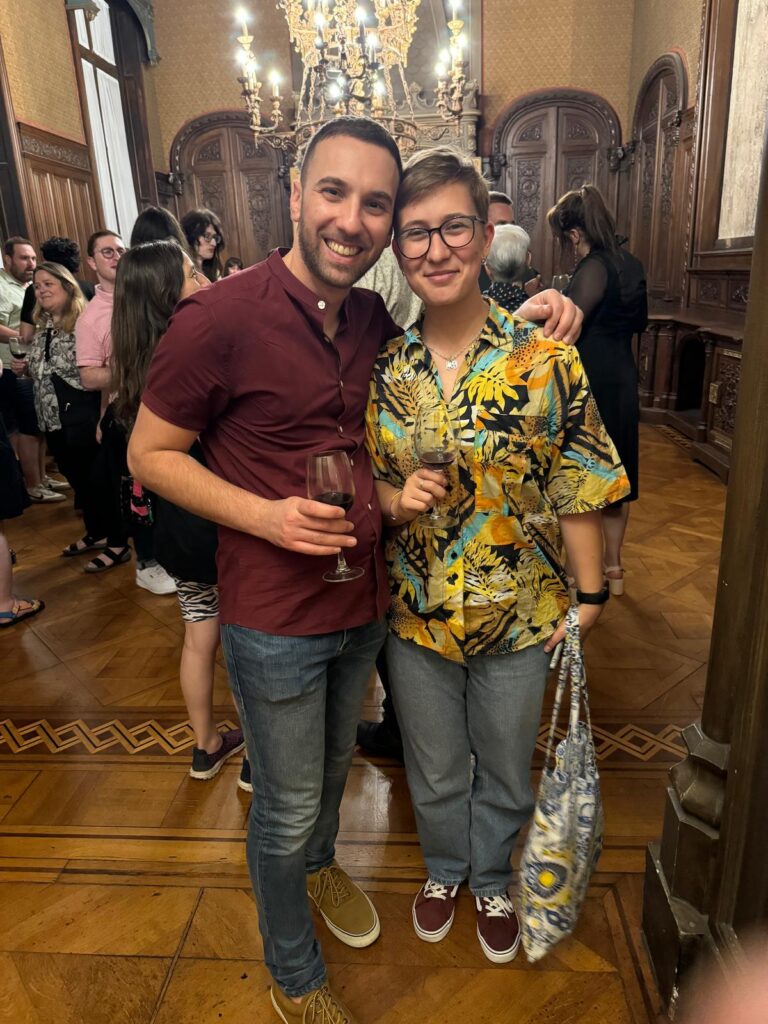
Entwine has been running LGBTQ+ Insider Trips for nearly a decade — Uruguay and Argentina in 2017, Berlin and Budapest in 2018, Prague and Berlin in 2025, and more. To date, we have run five trips across five cities and spent nine years bringing queer Jewish young professionals into community with one another, helping build vibrant queer Jewish life around the world.
The stories look different in each city. And that’s no surprise — the histories are different, the synagogues are different, the people are different. But one truth holds across all of them: When community shows up, when it widens to receive who is actually there, the fundamental experience of being in that community shifts. In community-building, we refer to this as the “structure of belonging,” the architecture a community builds so that the people who walk in don’t have to fit in to be received. Romina and Victoria weren’t asked to fit in. The chuppah was built around them.
Jewish tradition has been telling a version of this story for a long time. One of Judaism’s core ancient rituals was bringing the first fruits of the harvest to the Temple in Jerusalem. A pilgrim would carry a basket of the seven species, figs and pomegranates, olives and dates, wheat and barley, and grapes. They would set the basket down before the priest and recite aloud, in Hebrew, a passage from Deuteronomy that tells the story of the Jewish people’s journey from slavery to the land.
The Mishnah, the earliest layer of rabbinic law, picks up on a specific concern in a tractate called Bikkurim. Originally, pilgrims who knew the words would recite them themselves. Pilgrims who didn’t know the words would have someone read them aloud, and they would repeat after them. The Mishnah tells us that those who didn’t know the words began refraining from bringing first fruits altogether. The rabbis recognized that the ritual itself was driving people away. People couldn’t bear to be marked, in front of the whole community, as the ones who didn’t know.
So the rabbis changed the ritual. From that point on, the words would be read aloud for every pilgrim, and they would all repeat them. Those who knew the words did it the same way as those who didn’t. No one stood out anymore. Everybody brought their fruits. Everybody fulfilled the blessing, and thus the obligation.
On the surface, this could be read as a story about literacy. Underneath, it’s about a community noticing that some of its members had been left outside the ritual, and choosing to redesign the ritual rather than redesign the people.
The Mishnah is doing something deeply queer: saying communities change. The original ritual was probably designed for the people in front of the designers at the time. Communities grow. As they grow, the rituals have to grow with them, or they stop being rituals for the whole community.
That’s a move local Jewish communities have been making around the world. It’s also a move JDC has been making alongside them for more than a century. In more than 70 countries since 1914, JDC has organized itself around the Jewish community that’s actually present. That widening is the work.
Romina and Victoria weren’t asked to fit in. The chuppah was built around them.
And it’s work I am deeply proud of. I’m proud of Romina and Victoria, whose wedding became a piece of communal history because they wanted to love each other, and they wanted to do it in their own Jewish community. I’m proud of the Argentine Jewish community, which widened its tent. I’m proud of Entwine, which has been bringing queer Jewish young professionals into these rooms for nearly a decade, because seeing what’s possible elsewhere changes what’s possible at home. I’m proud of the people I’ve traveled with, and how they’ve continued to show up on our trips. And I’m proud, nine years after my first LGBTQ+ Entwine Insider Trip to Uruguay and Argentina, to still be working toward a Jewish world where queer people are not only invited to the table, but are among the people who build it.
That work is happening, and it continues as we evolve into the future. In Buenos Aires, Romina and Victoria are married, ordinary, and joyful. The first fruits are still being carried, in Buenos Aires, in Berlin, in Budapest, in Prague, and in every city where someone is building a Jewish life they were once told they couldn’t build. If the community is the table, let’s keep widening who builds it alongside us, for the next 100 years and beyond.
Andrew Belinfante is senior director of programs and organizational development at JDC Entwine, where he provides senior leadership for global programs that connect young adults to Jewish communities worldwide and strengthen long-term engagement with humanitarian and disaster-relief efforts. He has spent more than 15 years in Jewish communal life as a facilitator, program designer, and organizational strategist, and he serves on the boards of Jewish Queer Youth and You’re Just My Type.
Sign Up for JDC Voices Stories
Share


Share
Partners


Give With Confidence


