

Seeking the Warmth of the Fire: Insights from the 2026 JDC Entwine Ralph I. Goldman (RIG) Fellow
Global Jewish life is only as inclusive as we allow it to be — this rising Jewish leader has an idea about how to make it more open.
By Hillel Debow - 2026 JDC Entwine Ralph I. Goldman (RIG) Fellow | November 16, 2026
When you visualize the Jewish world, what do you see? Is it a distinct unit separate from the society that surrounds it? Or is it something more open? Hillel Debow — the 2026 JDC Entwine Ralph I. Goldman (RIG) Fellow — asked himself these questions on a recent trip to Budapest. And at the JDC-supported Mozaik Hub, a professional platform for Jewish community NGOs and initiatives in Hungary, he began to find answers.
Here’s what Debow discovered.
A Jew is stranded alone on a desert island. When he’s finally discovered, the rescuers find two synagogues he built. “Why two?,” they ask. “This one I pray in,” he said “That other one I wouldn’t set foot in.”
This joke is sad, but familiar. It is often easier to explain who we are by pointing to who we are not — to define identity by its boundaries rather than its center. My time in Budapest and conversations with JDC professionals there helped me rethink this all-too-common mindset.
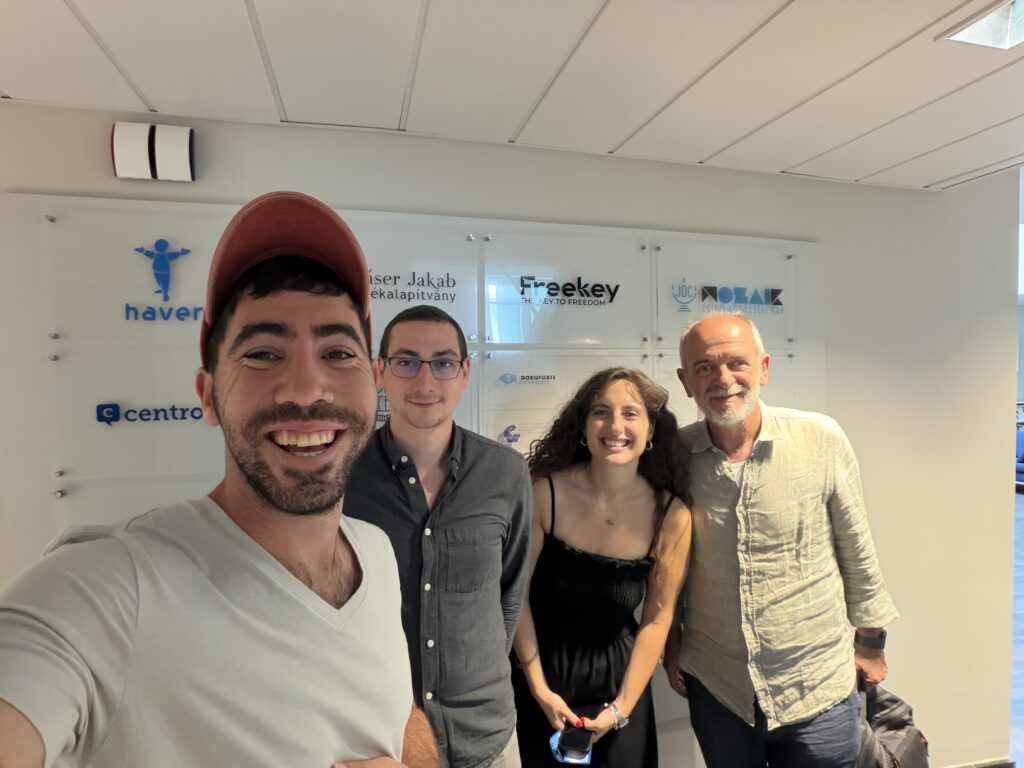
I visited the Mozaik Hub, a JDC program supporting Jewish community organizations, leaders, professionals, and volunteers in Hungary and met with Mircea Cernov, JDCHungary director and the Mozaik HUB manager when the program was initiated in 2014.
Mozaik Hub primarily supports Jewish community organizations and initiatives, helping them strengthen their work and become more effective at what they do. At the same time, its trainings and workshops are open to organizations across Hungarian civil society, creating opportunities for learning, cooperation, and partnerships with the Jewish community.
That openness raised a reflexive question in me. I asked myself: “If Mozaik Hub is firmly rooted in the Jewish community but also creates space for the broader NGO world, what makes its work distinctly Jewish?”
The answer I discovered brought new insight into how I view my Judaism. I came away thinking that an organization does not need to constantly announce or defend its Jewish identity. In the Mozaik Hub’s case, its Jewish identity is rooted in the community it serves, but it doesn’t end there. It is also reflected in the values that guide its people, the way they approach their work, and the relationships they build. Even when working with non-Jewish organizations, something distinctly Jewish spills over — not simply because of who they are, but because of how they see and engage with the world.
I had approached Mozaik Hub looking for a boundary, asking, “Where does the Jewish community end and the broader NGO world begin?” But my time there left me with a different framing: Find the center, not the boundary.
Still, I had another question about Jewish engagement in Hungary. After the fall of communism, JDC and others invested enormous energy in helping Jews rediscover, recover, and explore their Jewish identity. Decades later, I wondered what that work should look like now.
How much should we continue actively searching for Jews who are disconnected from communal life? How much should we invest in those who have already chosen, in one form or another, to participate?
I thought I was asking a question about resources, but I found an answer that complicated the categories of Jews I’d taken for granted in the first place. What does it mean to be “engaged”? Is someone engaged if they attend synagogue every week? If they send their child to Szarvas Camp? If they come to a Jewish cultural event once a year? If they study? Volunteer? Donate? Build relationships with other Jews?
The more I thought about it, the harder it became to draw the line I had been looking for, between Jews on the inside and Jews yet to be engaged. In conversations with Mircea, I started to think more about a progression: reach, first participation, repeated participation, relationships, belonging, contribution, leadership, and responsibility.
That gave me a different picture — not a gate with people standing on either side of it, inside Jews and outside ones, but more like a campfire. A campfire has a clear center. You know where it burns most intensely. But where exactly does it end? Close to it, you feel the flames. Farther away, the heat. Farther still, perhaps only the light. At some point you barely feel it at all, but it’s hard to point to an exact place and say, here the fire ends.
A wall works differently; it tells you where the boundary is. This side. That side. Inside. Outside.
Judaism certainly has walls. Halacha is full of boundaries, definitions, distinctions, and obligations. Those distinctions matter. A meaningful tradition cannot simply dissolve every line. But I have begun wondering whether the wall is the best prism through which to view Jewish identity.
Someone drives to join his family for Shabbat dinner. If I look at Jewish identity as a wall, I immediately notice the boundary crossed — the man drove on Shabbat. But if I look at Jewish identity as a campfire, I notice something else. They came for Shabbat. They wanted to sit around the table. To hear kiddush. To eat with their family and celebrate their tradition. They chose to come home to something that pulls them.
Both are true.
I do not think one perspective discounts the other. The halachic question remains real. But I think the second primes us to see other things.
What draws someone back? What do they care enough about to show up for? What do they want to pass on? What still has enough meaning, warmth, or weight in their lives that they keep moving toward it?
And perhaps the same question applies to Jewish communal life more broadly. How much energy should we spend deciding exactly where the community ends? And how much should we spend strengthening what sits at its center?
The more I thought about it, the harder it became to draw a line between Jews on the inside and Jews yet to be engaged.
This has helped me better understand a line I read from Ralph Goldman, JDC’s legendary honorary executive vice resident, that we are “a single Jewish world: intertwined, interconnected.” My RIG Fellowship has given me the opportunity to encounter many Jewish communities this year that look, believe, and live very differently from one another. I now understand his words less as a claim that we are all the same and more as a responsibility to remain connected across those differences.
Perhaps that is part of tending the campfire: not erasing the distance between us, but tending the center and keeping it strong enough so that we want to move closer to the center and to one another.
I am not sure there is a clean answer, and perhaps that is part of what I am learning — but my focus has become strengthening the center, so more people want to come closer and enjoy the warmth and light.
Hillel Debow is the 2026 JDC Entwine Ralph I. Goldman (RIG) Fellow. Hillel was born in Cleveland to educators serving as shlichim and raised in a home grounded in community, Jewish learning, and responsibility. After returning to Israel, he studied at Yeshivat Ma’alot and Beit Prat’s Mabua program, deepening his spiritual world through Torah and Jewish philosophy. Drawn to meaningful engagement, he entered informal education, counseling teens at Camp Stone and later serving as a Jewish Agency fellow in Australia.
Hillel served as a navigator in the IDF’s Haruv Reconnaissance Unit and today is a Section Sergeant in the reserves, completing over 400 days since October 7, 2023. He works at Gesher, facilitating identity-based dialogue and earned a BA in Humanities and Middle Eastern Studies at Shalem.
Sign Up for JDC Voices Stories
Share

Share
Partners

Give With Confidence


