

Through Kidum, Building Sustainable Jewish Communities in Argentina
These two leaders are catalyzing Argentina's Jewish future through an innovative JDC program.
By The JDC Team | June 24, 2026
From demographic changes to economic crises, Argentina’s Jews have faced overwhelming obstacles in recent years. That’s why JDC invests in emerging leaders through our Kidum initiative, a network of 14 Jewish communities in Argentina’s provinces that face similar challenges and come together for virtual and in-person training.
We recently sat down with Javier Indelman, president of the Kehila (community) of Rosario, and Gabriel Yurevich, vice president of the Centro Unión Israelita of Cordoba (Jewish Community of Cordoba), for a conversation about their experience with Kidum. For both of these changemakers, Kidum has given them the tools to build a more hopeful Jewish future.
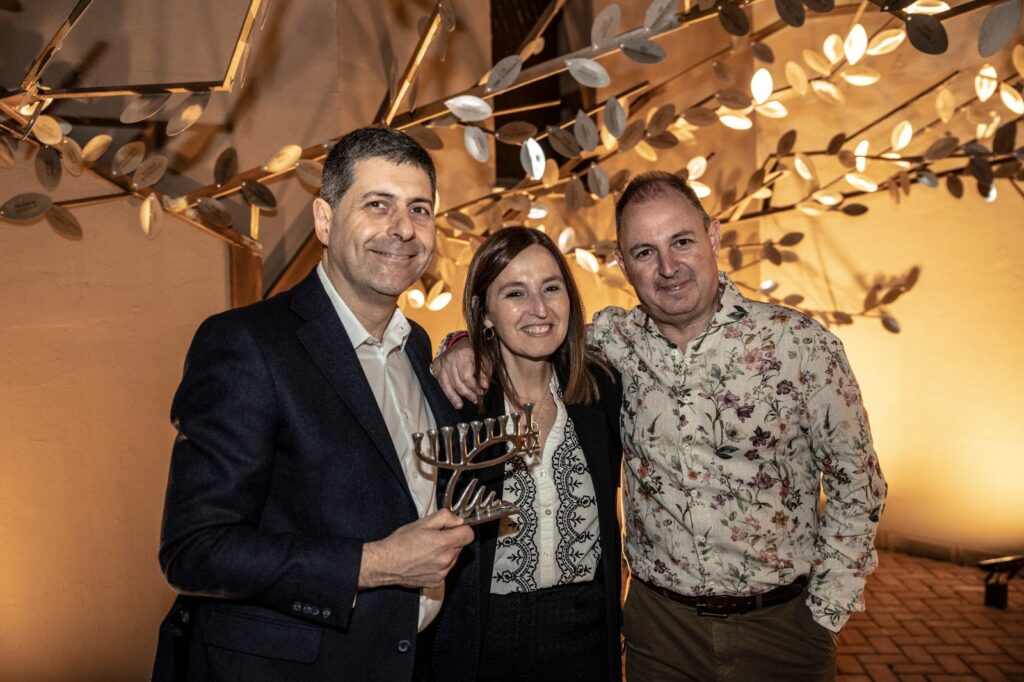
Tell us a bit about yourself. What’s your role today and how did you get involved with JDC?
Javier Indelman: I was born and raised in the community of Moisés Ville, and the community supported my family so that we could live and pursue our education. Therefore, I feel the need to give back to the Jewish community what it gave me.
I worked for five years in a smaller community, and since 1996, I’ve maintained a connection with JDC. I see them as a space for strengthening not only Jewish communities, but oneself.
In 2013, I had children in the Jewish day school, and together with a group of parents we wanted to make some improvements to the facilities. That’s how I began volunteering, and as of December 2025, I have once again been honored with the position of president of the Kehila of Rosario.
Gabriel Yurevich: My journey began in my youth as a madrich (counselor) at the Macabi Noar Jewish Community Center (JCC), where I discovered that education, mentorship, and community-building can change lives.
Today, I serve as Vice President of the Centro Unión Israelita of Cordoba (Jewish Community of Cordoba), with the conviction that communities do not sustain themselves — they require people willing to take responsibility and think long term.
What have you learned from the training you’ve received through Kidum?
JI: As volunteers we tend to think that what happens to us doesn’t happen to anyone else, and that the “problem” our community faces is unique. Kidum shows us that this isn’t the case.
First and foremost, Kidum is a mechanism for strengthening Jewish communal organizations. Participants are constantly thinking about how to build sustainable kehilot that will outlast us, how to ensure continuity (hemshej), and how to turn what we discover into processes that can serve everyone.
Clearly, this also means that we learn to listen, to analyze what we say and hear, to share ideas, and to express ourselves clearly. And then comes the greatest challenge — transforming all of this into a concrete work plan that we can truly implement and that motivates all stakeholders. Kidum teaches us how to do that.
GY: Of course, Kidum has taught me the hard skills any leader should know — keeping written minutes and outlining tasks and goals for all stakeholders. But I’ve also learned critical soft skills, like how to listen actively and ensure everyone feels included.

In what ways has Kidum empowered you to grow as a leader?
JI: I’m convinced that institutions are sustainable not because of individual leaders, but because of strong working teams. Effective leaders know that no individual is responsible for a team’s success; it’s a collective effort. That’s something I learned in Kidum.
One of my greatest joys is seeing that, at each Kidum gathering, more and more of us are traveling from Rosario to participate.
GY: Agreed. When it comes to leadership, Kidum helped me understand that our community organizations are delicate spaces — places where members come with different histories and perspectives. As a leader, you have to navigate that.
Learning to listen and read the communal room is one of the most important lessons I take with me.
Why is it important to have a place where Jewish leaders in Argentina can gather in one room?
JI: Without a doubt, it’s not only important — it’s essential. In our day-to-day work, we don’t have much time to reflect. Kidum offers a space where we can step out of our daily routines to think, listen, and analyze. We learn a great deal from the experiences of others.
Kidum also allows us to think about the future and reflect on where Jewish life in Argentina — and across South America — is heading. Based on that, we can make decisions and anticipate what lies ahead.
It is better for us to make decisions proactively rather than let time decide for us. That is what Kidum enables us to do.
GY: Within Argentina, we have communities facing similar challenges. Kidum has shown us that the ideas and projects developed by our fellow community leaders can be applied in our own settings if we regionalize them.
This has tremendous value, as it makes us far more efficient and impactful than if we were working in isolation, focused only on our own individual space.
What’s the single greatest challenge your Jewish community faces?
JI: I’ll list them from largest to smallest:
- How to envision the community over the next 15–20 years. In a world that has changed so dramatically, the model of communal life must evolve as well.
- How the community will adapt to demographic changes.
- How to build a more pluralistic community.
- How to develop an educational model that is both desirable and relevant for the youngest generation.
- How to build a strong and virtuous network — both within our own institutions and in connection with other communities.
GY: The lack of identity and commitment among members is the most significant challenge we face. When we add to this the low birth rate and the waves of emigration driven by the country’s recurring economic downturns, it creates a deeply concerning situation — one that we have been actively working to reverse.
In what ways does JDC help meet those challenges?
JI: JDC has been a steadfast partner in building and strengthening our local Jewish organizations. Since 2017, we’ve worked with JDC to rethink our school model and conduct volunteer training. Later, Kidum emerged as a framework for connecting different institutions.
GY: JDC enables us to develop mechanisms to analyze our greatest challenges. They don’t offer one-size-fits-all solutions or “recipes for success.” Instead, they invite us to delve deeper into the issues that concern us. That process helps us become strategic, not reactive.
JDC helps us develop tools to analyze our greatest challenges — they don’t offer one-size-fits-all solutions.
What’s your vision for your community in the next decade?
JI: Nothing meaningful is built alone.
That’s why I dream of a community that accompanies individuals through every stage of Jewish life, that serves as a leader in both formal and informal education — not only for Jews, but for Rosario as a whole. A community that supports the smaller neighboring communities and maintains a strong bond with Israel.
GY: I want a community stitched together by meaningful relationships, not just efficient services — a community where children are educated in a school of excellence, where young people find a space to make decisions and drive change. And last but not least, I want a community where the growing segment of adults and seniors can continue to actively enjoy Jewish life, contributing their experience.
What do you want to say to those who support Kidum?
JI: I tell them, “Toda Raba.” We like to say that an idea becomes good when it can be transformed into a strong project. A project becomes successful when it can be translated into a concrete work plan. And when we implement that plan, and see that it outlives us, the circle begins to close.
That’s what Kidum is today — something sustainable that will outlive all of us. Thank you.
GY: Kidum is the answer to communal renewal. Argentine Jewish communities have gone through periods of both flourishing and crisis. At this moment, trying to lead intuitively is no longer a valid option. The training of leadership teams — both volunteers and professionals — must be guided and intentional.
I’m inspired by the chance to leave behind a community that is stronger, more inclusive, and better prepared to face the challenges of the coming decades.
Kidum is that path forward, and I’m so grateful to all who support it.
Javier Indelman is the president of the Kehila of Rosario, and Gabriel Yurevich is the vice president of the Centro Unión Israelita of Cordoba (Jewish Community of Cordoba).
Sign Up for JDC Voices Stories
Share


Share
Partners

Give With Confidence


