

“Braided Together with All Jews”: A Meditation on Challah and Time
Week after week, there's one delicious thing Nina Podmoya receives from JDC that fills her appetite and her spirit.
By Nina Podmoya - JDC Client | November 2, 2026
Poetry lover, Holocaust survivor, and retired nurse, Nina Podmoya has led many lives in her 83 years on earth. And if there’s one thing she’s learned over these past eight decades, it’s that time is relentless — it stops for no one. The only thing that makes this continuous march forward bearable, according to Nina, is the mutual care and warmth we can offer each other on this long and breathless journey.
That’s precisely what she discovered at the JDC-supported Hesed Haim social service center in her home city of Sumy, Ukraine. In this reflection, Nina describes the many ways JDC sustains her, and how even something as simple as Friday challah delivery eases her loneliness and enlivens her spirit.
“Life goes on, with no chance for revisions/ And time flies by, never slowing its gallop…”
To paraphrase my favorite Ukrainian poet, Lina Kotsenko, life doesn’t give us the chance to rewrite what’s already happened. We can only continue moving forward. My own story begins two years before I was born, on the train that carried my father forward into one of humanity’s greatest catastrophes.
After the Nazis murdered his entire family, including his wife and small child, my father decided to enlist in the military. On the train to the enlistment office, he met a young teacher traveling to a village school. As the train galloped onward, my father and the teacher talked, exchanged addresses, and then went their separate ways.
Later, my father was wounded and recovered in a military hospital. When he was given leave, he was told to continue his recovery at home. But where could he go? His family had been killed, and his hometown was under Nazi occupation. Then he remembered the piece of paper with the teacher’s address.
The teacher lived in a village called Pidlisnivka. The entire region was under German control, but soldiers didn’t visit Pidlisnivka often. The local authority was vested in the hands of a policeman who watched the residents closely and followed Nazi orders. With a little bribe, though, he could be kept quiet. That was how my father found himself hiding in the house of the village teacher.
The women of the house tended his wounds, and one of them, Anna, became my father’s wife. I was born the following year in their cellar.
In those early years of my life, we lived under constant threat of being discovered and killed. My mother hid me as best she could. She was so undernourished she couldn’t feed me properly. The villagers knew that the teacher and his family were hiding Jews, yet they kept silent. Over time, my mother gave the policeman all her jewelry as payment for his silence. Somehow, time passed, and when the war ended, we could finally come out of hiding.
Growing up, I didn’t speak Yiddish or learn about my heritage. In place of a Jewish education, my father taught me a simple lesson: I had to be exemplary in everything — in my behavior, my studies, and later my personal life. He wanted me to live in such a way that no one could ever reproach me; he knew they’d already judge me for being Jewish.
I’d always dreamed of being a doctor, and maybe it was the desire to heed my father’s words that led me to medicine. When I was just 14, I entered the Sumy Medical School and trained as a feldsher, a medical professional who provided first aid and basic medical care.

I found this work meaningful. But my dream of becoming a doctor never faded. I applied three times to the Kharkiv Medical Institute. Unfortunately, this was the beginning of the 1950s, a time when antisemitism was becoming increasingly severe in the Soviet Union. I was more than qualified to study medicine, but I was refused admission because I was Jewish. It didn’t matter that I was exemplary.
I spent 20 years as the senior nurse in the neurology department. Though I never became a doctor, I never regretted choosing medicine. Helping ill patients recover and return to a full life made it all worth it, and one patient upended my life for the better.
I remember he was particularly weak and thin. At first I just felt sorry for him. We spent a lot of time talking, and I tried cheering him up. I soon discovered he was intelligent and well-read. Decades later, when I reflect on the moment I fell in love with my husband, I see that it was during one of our many discussions when I was a nurse and he was my patient.
My career lasted 50 years, time that flew by. But before I stopped working, at 67, I found my way to Hesed Haim. I knew I belonged there from the moment I stepped through the door. No one raised an eyebrow at my given name — Khaimivna, which made my Jewish ancestry immediately apparent. Whenever I had days off, I’d attend concerts, holiday celebrations, Shabbat gatherings, and the Women’s Club. I felt a sense of unity there, as if I’d finally found my Jewish family.
It’s funny how some childhood memories only make sense when you’re older. Hesed Haim threw certain moments into relief that I’d once considered strange or insubstantial. When I was a schoolgirl, for example, some of my father’s relatives came to Sumy from Leningrad for the summer — my father’s brother, his wife, and her mother. I thought the mother was fussy. She brought her own dishes and she wouldn’t eat this or that. Could anyone be so neurotic?
Only after attending Hesed Haim programs did I learn the reason behind her behavior. Her dishes were separate because they were kosher, and she didn’t eat many of the foods that other people around us ate because she followed the laws of kashrut.
I felt a sense of unity at Hesed Haim, as if I’d finally found my Jewish family.
After I retired, I needed something to occupy my time. That’s when I made the Hesed day center — a place for Jewish seniors like myself to socialize — a centerpiece of my life. I often prepared short presentations about interesting people and read poems. Even when I started having trouble with my legs and was unable to walk as vigorously as I used to, JDC arranged transportation to Hesed Haim.
Without JDC, I don’t even want to imagine what my life would look like. I worked hard for more than half a century, and yet my pension doesn’t even cover food and medication. JDC fills this gap, ensuring I never go hungry and that I receive adequate medical care. With their support, I sometimes even get myself little treats — things that I never would’ve allowed myself when I was young.
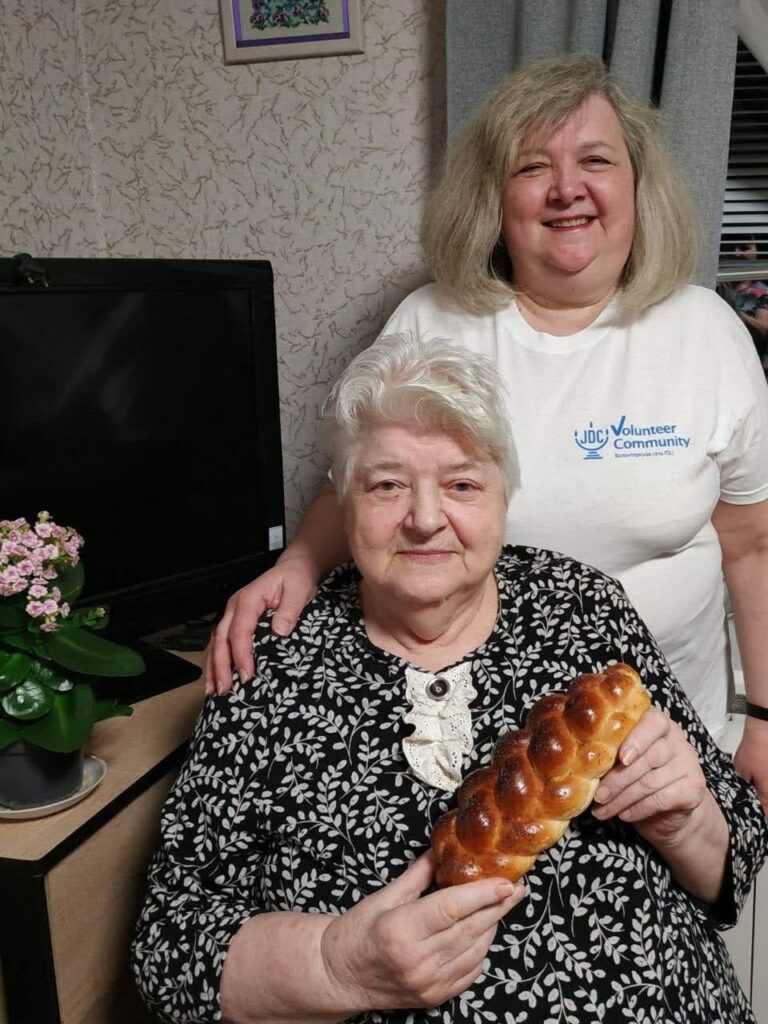
Each Friday, I receive challah through the Sumy Volunteer Community project. It is made by the hands of our JDC volunteers, and it’s so much more than just a delicious loaf of bread. When I receive it, I express gratitude to God for protecting us, and I feel braided together with all Jews who ever existed, including my ancestors. Shabbat is our time to step outside of time and gather strength from rest.
If I could go back and change one thing about my life, I would’ve traveled more and discovered more places and seen new things.
But life doesn’t give us a chance to revise the past — instead, it offers us the opportunity, in every moment, to write a new and better chapter for the future. We do that by helping our fellow Jews, and I’m grateful that JDC makes my own life bearable, even joyous, with their steadfast, expansive support.
Nina Podmoya, 83, is a JDC client in Sumy, Ukraine.
Sign Up for JDC Voices Stories
Share


Share
Partners


Give With Confidence


