

“We Survive Because of Each Other”: A Meditation on the Meaning of Tisha B’Av
Though he endured some of the worst atrocities imaginable, this Holocaust survivor never lost faith in his Jewish identity.
By Nicolai Boguslavskiy - JDC Client & Retired Engineer; Chișinău, Moldova | July 6, 2026
Energetic and sharp even at 88, Nicolai Boguslavskiy has never known a day of rest. Since the age of 3, when he fled his native Moldova during the Nazi invasion, Nicolai’s life has been one of hard work and overcoming seemingly impossible obstacles. Today, Nicolai finds strength and joy through the JDC-supported Hesed Yehuda social service center in Chișinău.
As Jews around the world mark Tisha B’Av, Nicolai opens about his experience during the Holocaust, the life-saving aid he receives from JDC, and why we must remember the past to build a more resilient future.
Life During Wartime
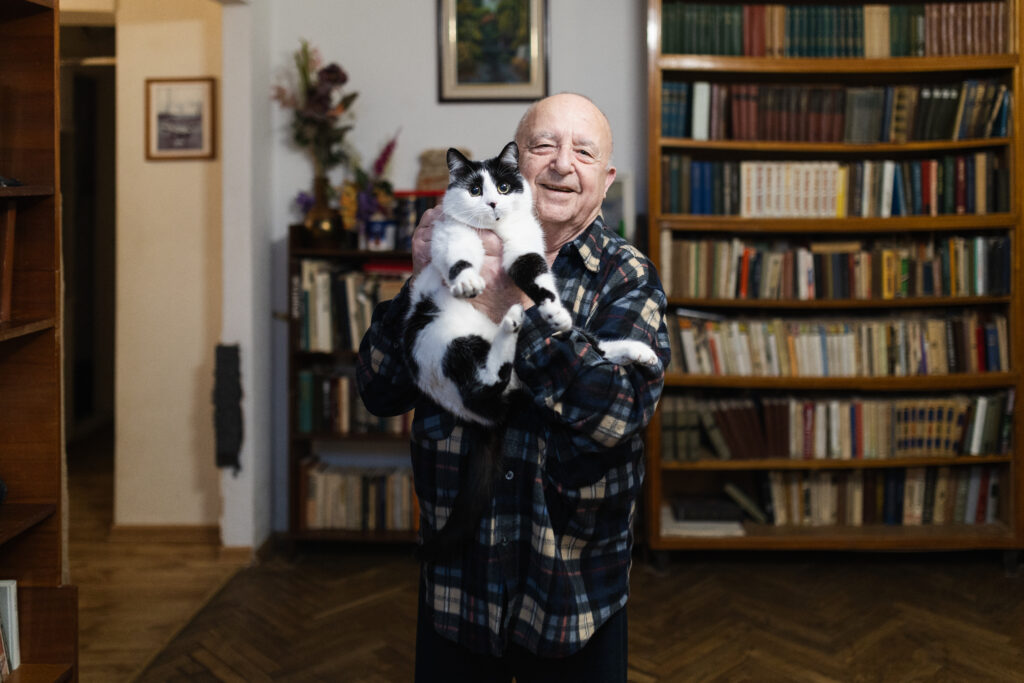
I once read that a person dies when they’ve exhausted their life’s purpose. I’ll be 88 in November — a beautiful number, two infinities stacked vertically — and I feel like I have a lot of time left. My life’s purpose is my work as an engineer, which, though I’m pushing 90, is still something of a hobby.
I was born on the eve of the Second World War in the very city I live now, my beloved Chișinău. Though I have fragmentary memories from before, I only became conscious of myself at about age 3, the year the Nazis invaded our homeland and my family was forced to evacuate.
We fled to Hadji-Abad, a remote village in Uzbekistan. Hadji-Abad is where, at 3 years old, my work experience began. Everyone had to work, including my elderly grandparents — there was nothing else one could do. We picked cotton by hand. I’d yank off the hard parts of the plant, pull out the soft cotton, and separate it. All these years later, I can still feel my torn, prickly fingers.
That brutal sensation lingered with me back to Chișinău, where my family returned to live in August 1944. Back then, the city was small — perhaps 15,000 people — and the only language I heard on the streets was Yiddish. My grandfather prayed several times a day and observed all the Jewish customs and rituals. My grandmother unfortunately didn’t have time for that; she was too busy with housework.
I was busy, too. From the age of 7, I’d started helping my father with odd jobs. He was an engineer and surveyor, and he taught me how to use his instruments. I’d hold out a measuring rod and operate his theodolite. At these times, I saw the path my life could take.
My Encounter with Antisemitism
That’s why I knew that, after graduating high school, I would apply to study mechanics. I was admitted to the school the first time I applied, and right before I earned my degree a few years later, I was slated to receive an award honoring my academic performance.
That’s when it was explained to me who I really was. I wasn’t going to receive any award because, well, I was Jewish. They weren’t even going to acknowledge the hard, honest work of a Jew.
That stung. But despite being cheated out of an honor I deserved, and despite the antisemitism that pervaded Soviet society, I decided I’d take my passion for mechanics and build a successful career.
Though I’m now retired, I still consider myself a professional engineer. This is my vocation, and I recently calculated the immense economic contribution I’ve made to society throughout my decades-long career. I only wish that I and so many other elderly Jews like me got back what we put in.
The (High) Cost of Living
To be frank, our pensions are a joke. You can’t even call them pensions. They fail to cover food, medicine, and other basic necessities. So many elderly people burden their families, and it ruins their lives, but I don’t even have that dubious luxury. My dear wife passed away years ago, and I miss her so much. I’m completely alone.
Little by little, my body has been failing me. First, my sense of smell disappeared, then my eyesight, and For two years, I haven’t been able to read anything — not printed text or what’s on a screen or even the large signs in front of stores. My hearing is going, too. When it’s all gone, what then?
There is no escape. It’s not as if I can stroll around the city and forget my problems. I can barely walk. At the same time, I have once never asked anyone for support in my entire life. In fact, I’ve always been the support. Even now, I’m always ready to help others. Everything I have today, I’ve worked hard for; I don’t like just standing around with my hand out.
Still, I don’t even want to picture what my life would be like without JDC. I know it would be a lot worse. I wouldn’t be able to afford anything, nor would I receive decent medical care. And without the healthy food I’m able to purchase with their help, I likely wouldn’t have made it to 88.
JDC: My Eyes, My Ears
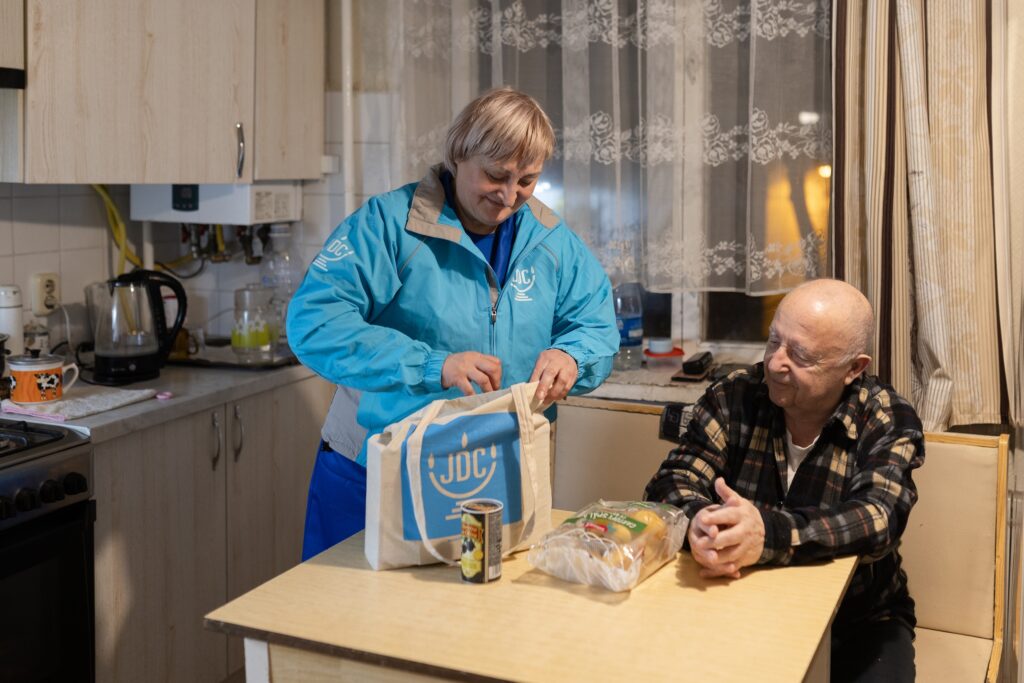
But I don’t survive just because of the food, medicine, and other essentials JDC provides me, crucial though these things are. I’m still alive thanks to the dedication and commitment of Valya, my wonderful JDC homecare worker. She’s already been with me two years, and we’ve grown very close.
Theoretically, I could walk to the store by myself, but crossing the street is scary because I wouldn’t be able to see the cars. But even if I miraculously dodged oncoming vehicles and made it to the store, I wouldn’t be able to read the labels. And with my bad legs, I’d have to stop every few steps.
But when Valya and I go out into the world, it’s wonderful! We often walk together, and we have our usual routes. She has a lot to tell me, and I have a lot to tell her. She is a source of joy and she helps me both mentally and physically. What I admire most about Valya is that, like me, she’s sharp and high-energy. Whenever she comes around, my house, so dark and lonely, is filled with light!
Plus, my cat took to her quickly, and I trust his opinion completely.
The Source of Our Collective Resilience
I believe that all Jews and all people should help each other, otherwise we can no longer call ourselves human. But it’s especially that important Jews support other Jews — the only reason we’ve survived one obstacle after another is because we’ve had each other.
I believe that all Jews should help each other. Otherwise, we can no longer call ourselves human.
Throughout our collective journey, there have been repeated attempts to strip us Jews of everything we have and drive us out of existence. Tisha B’Av is a powerful reminder that, in the midst of everyday life, we must stop and remember the catastrophe that unfolded more than 80 years ago as well as the destruction of the First and Second Temples.
We Jews are a stiff‑necked people — once we decide on something, it’s difficult to turn us from our path. Persistence seems to be our defining trait. I’ve had the great fortune of working with many different cultures, and I’ve come to understand just how accurate this description of our people is.
When I look at myself, I realize that I’m the same way. Though I’ve faced hardship, I do not feel sorry for myself. Everyone has their own challenges; what matters is how you come through them and what you take from that experience. Of course, I could have done more, and some things might have turned out more successfully — but I have no regrets and I don’t complain.
Perhaps that is precisely the reason why, after thousands of years, we are still here.
That’s thanks in no small part to JDC. Without their assistance and that of the Claims Conference — the organization’s partner in caring for Holocaust survivors like me — I wouldn’t feel free.
When I thank JDC for everything they’ve done for me and so many other Holocaust survivors, in the same breath, I also express gratitude for their supporters. Whether I’ve met them or not, they have touched my life more than they can ever know — they have given me a purpose, and so I continue to live.
Nicolai Boguslavskiy, 88, is a JDC client and retired engineer in Chișinău, Moldova.
Sign Up for JDC Voices Stories
Share


Share
Partners


Give With Confidence


